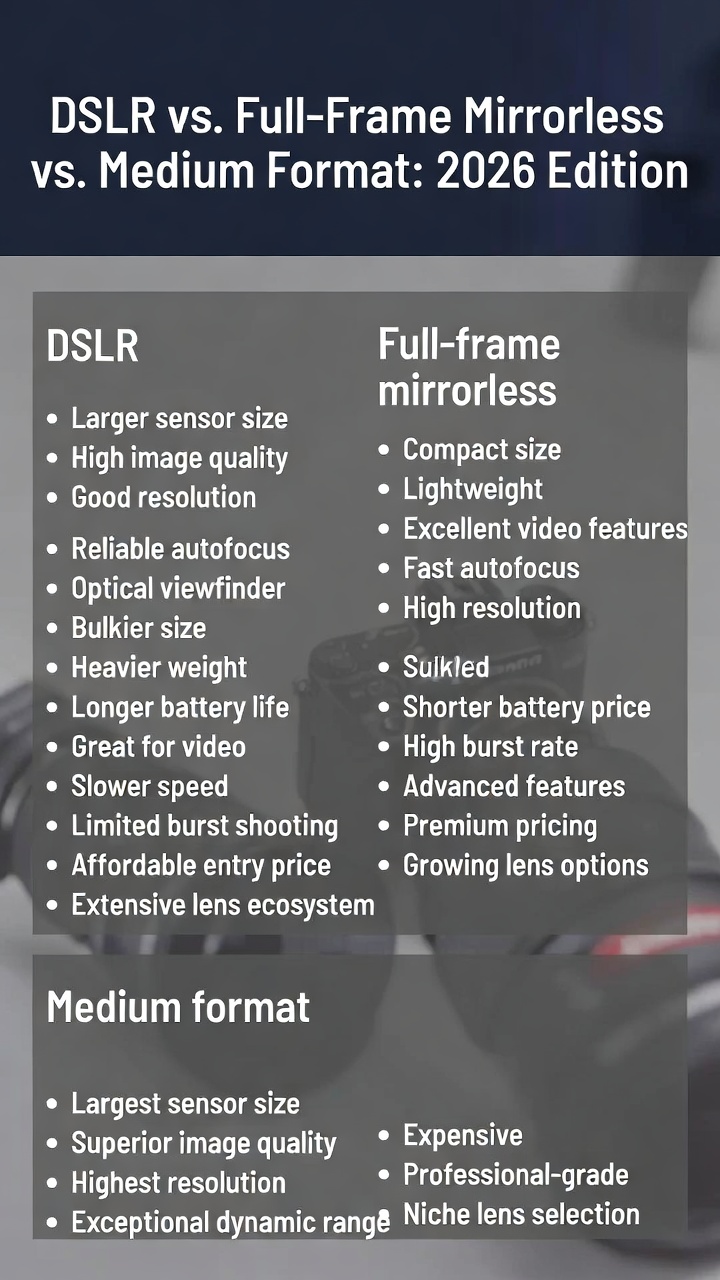
This blog reflects the landscape as of early 2026, where mirrorless systems dominate new development, DSLRs are mostly legacy/used options, and medium format remains a premium niche for maximum image quality.
Sensor size and image quality form the foundation of the differences. DSLRs (like the classic Nikon D850 or Canon EOS 5D Mark IV) typically use full-frame sensors (or sometimes APS-C), delivering excellent dynamic range, color accuracy, and low-light performance for their era. Full-frame mirrorless cameras match or surpass this with modern sensors that handle noise better, offer wider dynamic range, and support higher resolutions in many models. Medium format cameras, such as those in the Fujifilm GFX series (e.g., GFX100 II, GFX100S II, or newer variants), use significantly larger sensors—often around 44x33mm or bigger—which capture far more detail, produce smoother tonal gradations, cleaner files at base ISO, richer colors, and that signature “3D pop” in portraits and landscapes. The larger sensor area gives medium format a clear edge in pure image quality for critical work, though the difference is most noticeable in large prints, heavy cropping, or studio comparisons.
Resolution varies across the categories. Most DSLRs top out at 24–45 megapixels, which remains plenty for most uses. Full-frame mirrorless models commonly range from 24–60+ megapixels, with some offering pixel-shift modes pushing beyond 100MP for ultra-detailed stills. Medium format routinely delivers 50–102+ megapixels as standard (with rumors of even higher like 180MP in future GFX models), making it ideal when every pixel counts for massive enlargements or commercial/archival purposes.
Autofocus performance is where mirrorless pulls far ahead in 2026. DSLRs rely on phase-detect systems that are solid for static subjects but slower and less reliable for tracking moving subjects, especially in low light. Full-frame mirrorless cameras excel here with advanced AI-driven subject detection (including real-time eye AF for people, animals, birds, vehicles), blazing tracking speeds, and blackout-free shooting. Medium format autofocus has improved dramatically in recent models but still trails full-frame mirrorless in speed and reliability for action, sports, or fast wildlife—it’s better suited to deliberate, composed shooting.
Viewfinder experience differs noticeably. DSLRs provide an optical viewfinder that’s natural, lag-free, and excellent in bright sunlight with no power drain. Full-frame mirrorless uses electronic viewfinders (EVFs) that preview exposure, white balance, histograms, and focus aids in real time, which many find transformative, though some photographers miss the “real-world” feel of optical. Medium format cameras now use high-resolution EVFs that are excellent but still electronic.
Size, weight, and handling lean toward compactness in mirrorless designs. DSLRs tend to be bulkier due to the mirror box and prism, with heavier pro lenses. Full-frame mirrorless bodies are often smaller and lighter (though native full-frame lenses can still be substantial), making them great for travel or extended handheld use. Medium format bodies and lenses remain larger and heavier overall, but newer GFX models are surprisingly portable compared to traditional medium format gear.
Battery life favors DSLRs in many cases, often delivering 800–2000+ shots per charge thanks to lower power demands. Full-frame mirrorless typically gets 300–700 shots (improving in newer models with better efficiency), while medium format usually offers fewer shots due to high-resolution sensors and processing.
Video capabilities are limited on most older DSLRs (basic 1080p or early 4K at best). Full-frame mirrorless leads strongly with 8K options, high frame rates, excellent stabilization, and pro-level codecs in many bodies. Medium format video is capable in some models but rarely the primary focus—it’s more about stills excellence.
Speed and burst shooting see DSLRs hitting 7–12 fps typically. Full-frame mirrorless pushes 20–30+ fps with no blackout, making it ideal for sports, wildlife, or events. Medium format is slower, often 5–10 fps, prioritizing quality over rapid fire.
Pricing in 2026 puts DSLRs in the affordable. Mirrorless are bit expensive…while. Medium format starts are very expensive with lenses also premium-priced.
Lens ecosystems remain vast for DSLRs via huge used markets (F-mount, EF), though no new development occurs. Full-frame mirrorless enjoys massive, growing native lens lines plus easy adaptation of older glass. Medium format has a solid but more limited and expensive selection, focused on high-quality primes and zooms.
Best use cases summarize the choice. DSLRs suit budget-conscious shooters, those who already own compatible lenses, prioritize battery life, or prefer the classic optical viewfinder feel. Full-frame mirrorless is the versatile, future-proof pick for most industrial and corporate videographers—excelling in general use, travel, action, portraits, video, and more. Medium format shines for professional studio work, landscapes, fine-art portraits, cxo headshots, commercial photography, or anyone needing the absolute best detail and tonal quality (especially for large prints), where the extra cost and size are justified.
Contact Us Today : for Any Industrial film or Corporate video project
d
Mobile Number : +91 7042111335
WhatsApp Number : +91 7042111335
Email : info@cutsncamera.in
Website : http://www.cutsncamera.in , http://www.cutsncamera.com