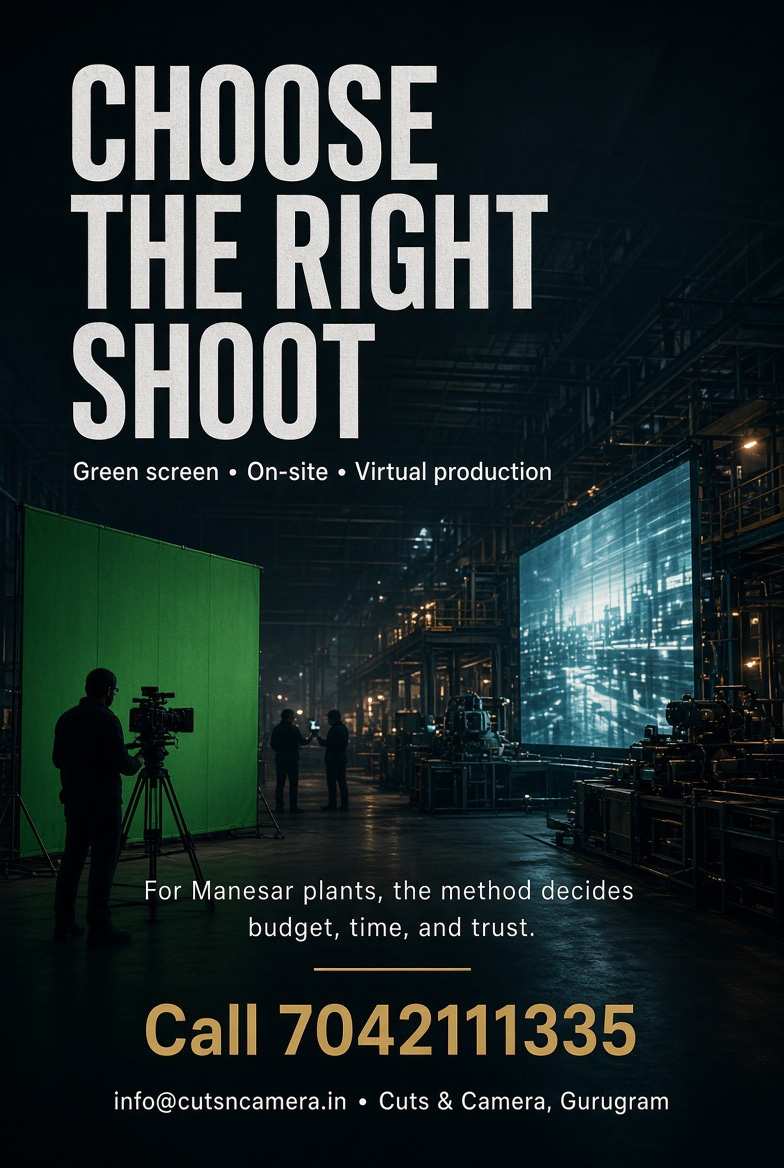
Green Screen, Real Location, or Virtual Production — Which Filming Method Fits a Manesar Corporate Film?
The method you choose decides more than the look of the film. It decides budget, shoot days, risk on a live plant, and whether the audience believes what they see.
For manufacturers, logistics operators, and enterprise teams across Manesar — Binola Industrial Area on NH-48, the NATRIP cluster, Bhora Kalan / Binola stretch, M3M GIC / Sector M9, Nawada Fatehpur, IMT Manesar Phase VI, and the Patli–Hazipur pocket — the right call is not “which technique is newest.” It is which technique matches the job.
1. Green screen (chroma key studio)
Use it for: Executive interviews, spokesperson films, modular training, and content you will reuse with different backgrounds.
Why it works: Weather, plant access, and travel drop out of the equation. One controlled studio day can produce multiple versions. Backgrounds can change in post without another shoot.
Watch-outs: Lighting has to be precise. Poor keying looks cheap and undermines a premium brand. It also cannot prove scale — a painted or stock backdrop will not replace a real shop floor.
Best when: The message is the person and the script, not the facility.
2. Real location (on-site filming)
Use it for: Plant walkthroughs, brand anthems, process films, safety and capability films, investor or OEM proof-of-scale content.
Why it works: Nothing builds trust like an active line in Binola, a testing workflow in the NATRIP cluster, or heavy operations along Bhora Kalan. Global buyers and auditors want to see the building, the equipment, and the people who run it.
Watch-outs: You are working around shifts, PPE, noise, and restricted zones. Planning, permissions, and a crew that already understands industrial sites matter more than camera specs.
Best when: The asset itself is the argument — infrastructure, capacity, new Phase VI development, or expansion at Patli–Hazipur.
3. Virtual production (LED walls / in-camera VFX)
Use it for: Product launches, complex demos, multi-city or multi-plant stories shot in one controlled space, high-concept brand films.
Why it works: Talent stands in a real set while the world behind them is rendered live. Lighting stays consistent. You can “be” in several locations in a day without flying a crew to each one. Useful for tech-forward firms in M3M GIC / Sector M9 that need a futuristic frame without a week of travel.
Watch-outs: It is not automatically cheaper. LED stages, real-time 3D, and specialists cost money. If the goal is to show your plant, a virtual hall is still a virtual hall.
Best when: The story needs environments you cannot shoot, or the timeline cannot absorb multi-site logistics.
How to choose
If you need to prove plant, process, people, and scale, shoot on location.
If you need fast interviews, training modules, or reusable talking heads, use green screen.
If you need a concept world, a product environment, or many “places” in one day, use virtual production.
If you need both leadership presence and factory proof, film the plant on site and the interviews in studio.
Ask three questions before you lock the method:
- Does the audience need to see our site, or only hear our people?
- Can we give a crew safe, timed access to the floor?
- Is the extra cost of LED/VFX buying a result we cannot get on site?
On-site still wins when the brief is infrastructure near Nawada Fatehpur, a new Phase VI plot, or operations across the Manesar corridors. Studio and virtual workflows win when the calendar is tight or the story is conceptual.
Cuts & Camera plans the method around the brief — factory floors across Manesar’s industrial belts, controlled studio interviews, or virtual-production setups when the story needs them — with a fixed scope so the format does not become a surprise cost.
Cuts & Camera Productions
Gurugram
Call: 7042111335
Email: info@cutsncamera.in
www.cutsncamera.in